
Forging European C-UAS Architectures: Boryviter Briefs EU Officials on Defeating Hybrid Drone Threats
Advanced C-UAS hardware is operationally obsolete without rigorous system integration. Boryviter briefed EU defence planners at the ESDC in Brussels on forging resilient, multi-layered air defence architectures to defeat asymmetric drone threats.
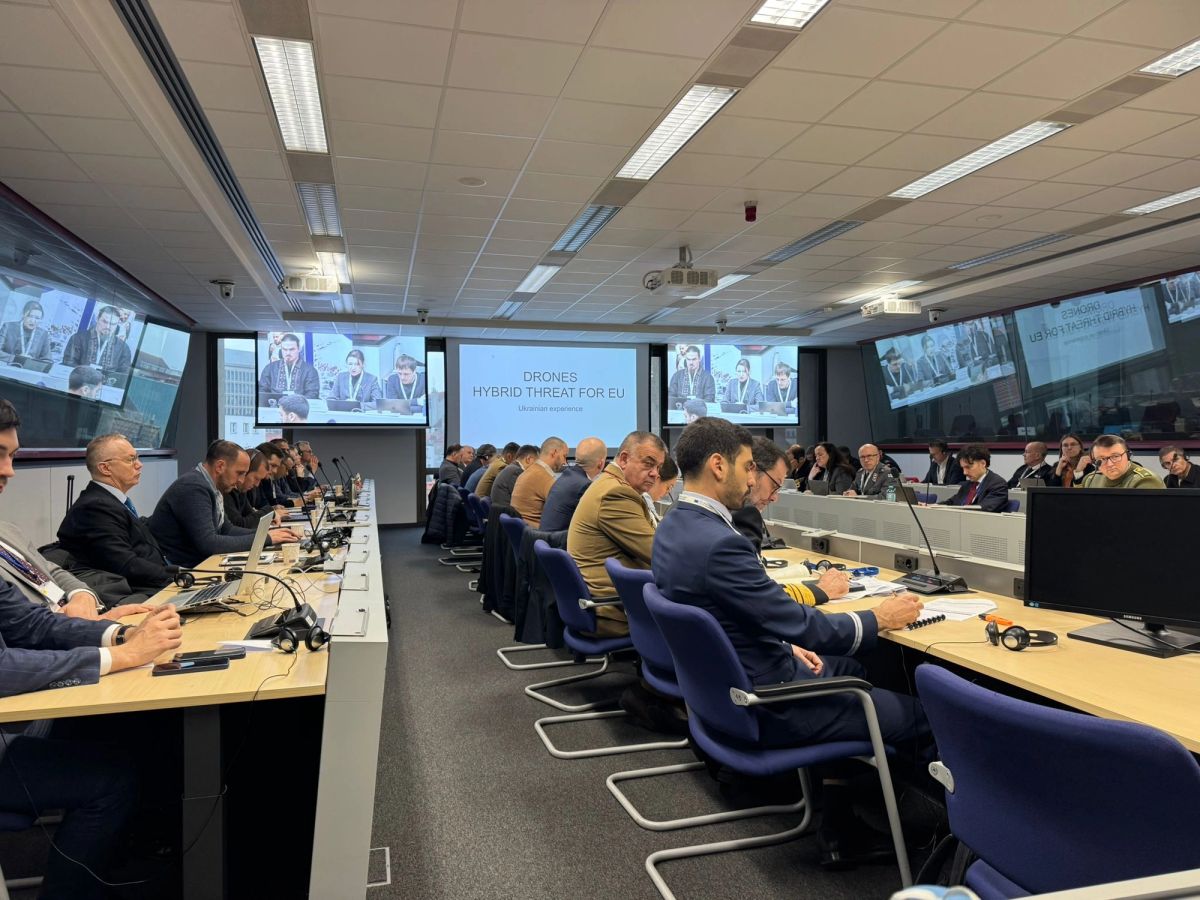
The proliferation of unmanned aerial systems has fundamentally altered the European security landscape. Autonomous systems and loitering munitions have evolved into asymmetric hybrid threats capable of paralyzing critical national infrastructure without triggering immediate military escalation. To address this critical capability gap, the Boryviter Centre of Excellence delivered an in-depth operational briefing on Counter-UAS (C-UAS) architectures to European Union officials during a dedicated seminar hosted by the European Security and Defence College (ESDC) in Brussels on 9-10 February.
The two-day conference, titled "Countering the Hybrid Threat from Drones," brought together senior representatives from the European External Action Service (EEAS), EU Military Staff (EUMS), European Defence Agency (EDA), and allied defence ministries. Acting as the primary subject-matter experts on active combat environments, the Boryviter delegation translated raw, zero-line data into unclassified strategic foresight for European capability development.
During the briefing, Boryviter’s Chief Technology Officer, Illia Kukharenko, and Director for International Relations, Tetiana Ostra, deconstructed the rapid evolution of adversarial tactics. The presentation covered the full spectrum of emerging threats: from the deployment of swarming decoys designed to exhaust multi-million-euro air defence systems, to deep-strike munitions utilising mesh networks and advanced Controlled Reception Pattern Antennas (CRPA) to bypass conventional jamming.
However, the central thesis of Boryviter’s briefing was a stark warning to European defence planners and industry representatives: advanced hardware is operationally obsolete without rigorous system integration.
"A state-of-the-art counter-drone system evaluated in a sterile testing environment frequently becomes merely a piece of metal on the battlefield without proper system integration," the Boryviter delegation emphasised. Procuring standalone sensors or effectors is insufficient against mass-produced, adaptable threats. Building a resilient C-UAS shield requires a multi-layered "system of systems" approach:
- Sensor Fusion & Radar Fields. Transitioning from isolated detection nodes to interconnected, macro-level radar networks.
- Distributed EW Networks. Deploying resilient, multi-node Electronic Warfare architectures capable of countering autonomous navigation and mesh-communication UAVs.
- Kinetic Interceptors. Scaling AI-assisted, hit-to-kill interceptor drones to neutralise targets cost-effectively, avoiding secondary explosive damage over civilian infrastructure and airports.
Furthermore, the delegation addressed the urgent need to overcome "paper warfare" – lengthy bureaucratic procurement cycles that fail to match the adversary's rapid technological iteration. By sharing the operational mechanics of Ukraine’s "Iron Polygon" (a framework for the rapid, live-environment testing of defence tech), Boryviter demonstrated how allied nations and original equipment manufacturers (OEMs) can drastically accelerate the deployment of combat-ready C-UAS solutions.
Ukraine is an integral component of the European security architecture. Through systematic engagement with EU defence structures, Boryviter continues to serve as an expert bridge. The Centre stands ready to assist European governments and defence contractors in transforming fragmented technologies into robust, interoperable air defence networks capable of neutralising the threats of tomorrow.