
Command, Control, and Leadership (C2)
Adapting operational planning and mission command to extreme resource and time constraints using advanced wargaming.
The Operational Challenge
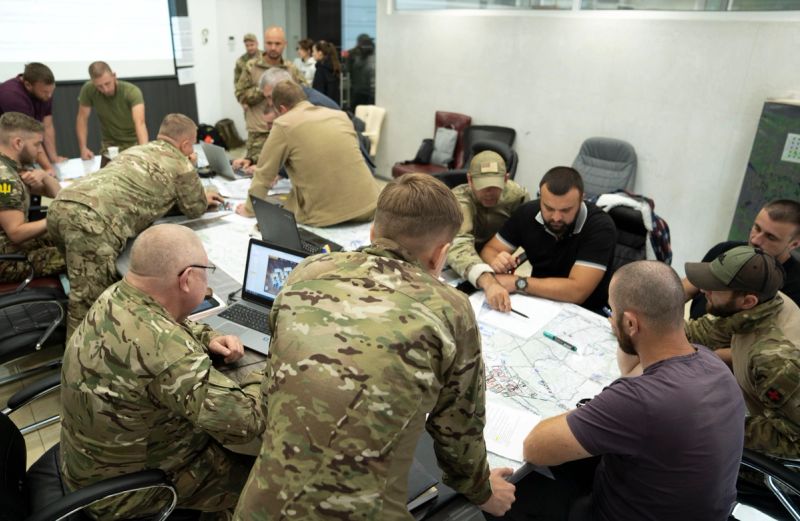
Executing NATO-standard operations is critical, yet classical military doctrines often assume air superiority, secure communications, and ample planning time. In the reality of modern, high-intensity conflict, command staffs must execute the Military Decision-Making Process (MDMP) and Troop Leading Procedures (TLP) under extreme stress, severe resource constraints, and continuous adversarial monitoring.
Building the Capability
Boryviter's Command, Control, and Leadership branch is exclusively veteran-led. Our Subject-Matter Experts, who possess direct combat command experience at the brigade level and above, adapt established staff procedures to the unforgiving realities of modern asymmetric warfare. We prepare the next echelon of military leaders to execute decisive action when theoretical doctrine meets raw combat friction.
Core Domains of Expertise
Implementation across multidomain environments
Military Decision Making Process (MDMP)
Brigade, regimental, and battalion-level command execution, encompassing intelligence (ISTAR integration), operational planning, fire support C2, uncrewed systems units C2, communications and EW deployment, engineer support, logistics, and Civil-Military Cooperation (CIMIC).
Troop Leading Procedures (TLP)
Company and platoon-level mission planning and decentralised command and control execution.
NCO Development
Empowering the Non-Commissioned Officer corps through combat leadership, land navigation and map reading, tactical medicine fundamentals, small-unit tactics, and fires training.
Digital C2 and Simulation
Integrating automated architectures, including advanced simulation systems for combat wargaming, situational awareness platforms, and combat management systems.
Impact
Staff-Level Operational Planning
Preparing battalion, regimental, and brigade staffs to plan and command under extreme pressure.
Rather than relying on classroom theory, Boryviter delivers modular staff preparation in a format designed to mirror operational practice as closely as possible. Through wargaming, battle simulation, and an adapted Military Decision-Making Process (MDMP), we help staffs develop realistic courses of action more quickly and synchronise intelligence, fires, UAS, communications, electronic warfare, engineering, and logistics within a single plan. This strengthens a staff’s ability to make decisions and execute complex combat orders under time pressure, resource constraints, and constantly changing conditions.
Flexible Rotation Models
Modular staff preparation without removing an entire headquarters from the operational cycle.
Recognising that active combat formations cannot afford to withdraw an entire headquarters from the front at the same time, Boryviter applies flexible rotation models to prepare individual staff elements through intensive modules. This approach has already been used with high-readiness formations and allows planning, coordination, and command skills to be strengthened progressively without disrupting operational continuity. As a result, units build staff capability without stepping out of the rhythm of combat operations.
Integrating Simulation into Operational Planning
Adapting, localising, and integrating a partner-nation simulation system through the training of commanders, staffs, and instructors.
Boryviter adapted and translated into Ukrainian a modern tactical-level simulation system from a partner nation and, through training, integrated it into operational planning and unit preparation. It is used for course-of-action analysis, wargaming, synchronisation of complex operations, and scenario rehearsal on realistic models of Ukrainian terrain. This allows commanders and staffs to identify critical errors at the planning stage, refine their concept before execution, and systematically improve the quality of command decisions.
* Much of the work carried out within this line of effort is not disclosed publicly due to operational security requirements.
For further details, please contact us directly.